


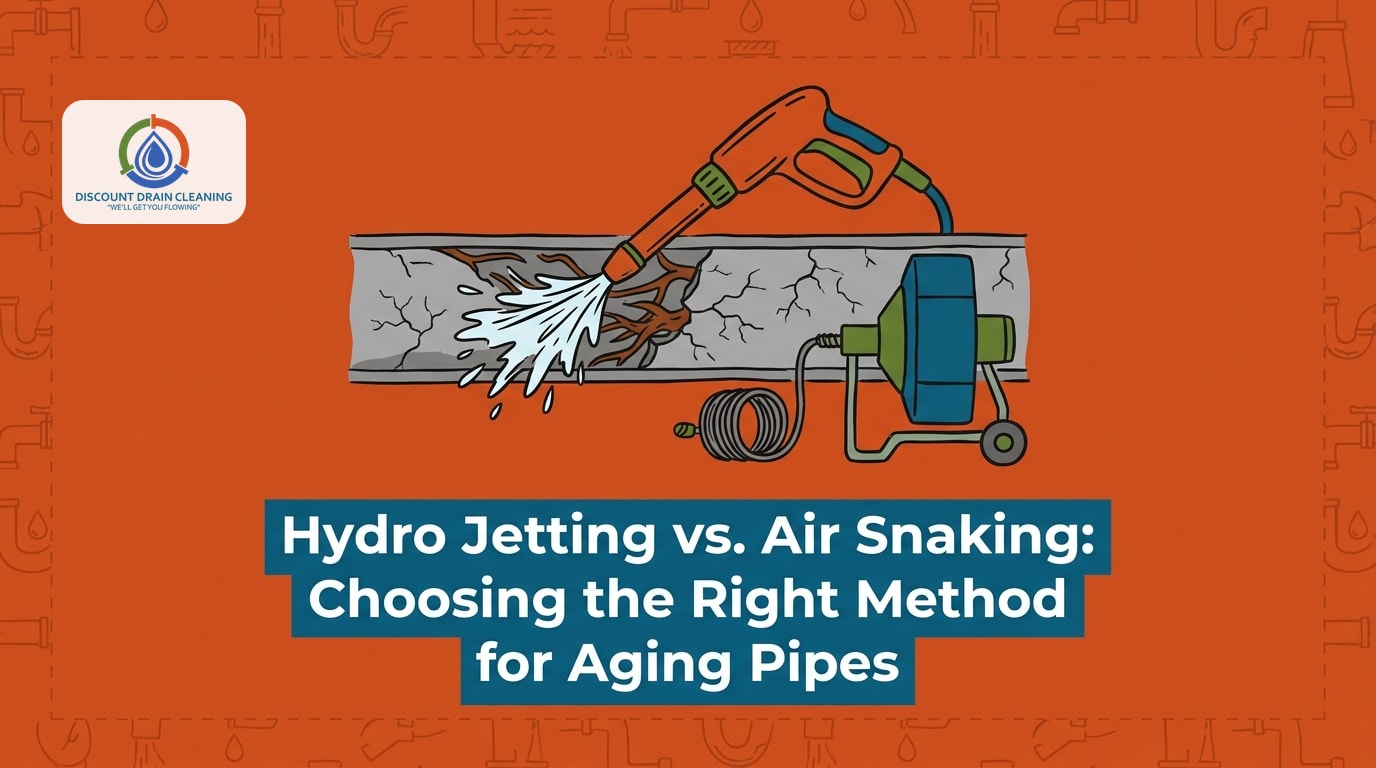
The Myth of Maximum Pressure: Why Older Pipes Need a Gentle Touch
Bigger isn’t always better, especially when it comes to residential plumbing. There is a common misconception that the best way to clear a stubborn clog is to blast it with the highest water pressure possible. When evaluating Hydro Jetting vs. Air Snaking: Choosing the Right Method for Aging Pipes, assuming that maximum force is the universal answer can actually lead to catastrophic property damage. At Discount Drain Cleaning, we’ve seen firsthand that if you live in one of the older residential neighborhoods in Las Vegas, NV, your home likely relies on aging, fragile plumbing infrastructure that requires a much more calculated approach.
Homeowners dealing with severe, recurring drain clogs—such as those caused by massive tree root intrusions—face a critical decision point. Do you authorize high-pressure water clearing to obliterate those stubborn blockages, or do you opt for safer, pneumatic air snaking methods to preserve your delicate pipes? Making the wrong choice can turn a routine maintenance call into an emergency excavation. To protect your property, you need to understand the safest, most effective drain cleaning methods available today.
The core problem: You want the blockage gone permanently, but the very pipes holding that blockage might shatter under the stress of aggressive clearing. Balancing maximum clearing power with structural preservation requires moving past the myth of maximum pressure and looking at the actual condition of your underground infrastructure.
Understanding the Vulnerability of Aging Plumbing Systems
Before you can make an informed decision about the hydro jetting process, you must understand exactly what is buried beneath your front lawn. Homes built several decades ago were constructed using plumbing materials that were standard for their time but are now reaching the end of their functional lifespans. The two most common materials found in older sewer lines are cast iron and vitrified clay.
According to data from the International Association of Certified Home Inspectors (InterNACHI), both cast iron and clay pipes generally have expected lifespans of 50 to 100 years. However, this lifespan assumes ideal conditions. In our experience servicing the local area, we’ve found that these materials degrade much faster when subjected to environmental stress. Over decades, our team typically sees a specific sequence of degradation occur:
- Internal Scaling and Tuberculation: Cast iron pipes naturally rust from the inside out. This creates a rough, jagged surface known as tuberculation, which catches debris and narrows the inner diameter of the pipe, making the walls thinner and more brittle.
- Joint Separation: Clay pipes were typically installed in short segments. Over decades of shifting soil, seismic activity, and ground settling, these joints pull apart or become offset, creating weak points in the line.
- Micro-Fracturing: The constant expansion and contraction from temperature changes causes microscopic cracks to form along the length of both clay and cast iron lines.
- Structural Compromise: Once the walls are thinned and the joints are weakened, the pipe loses its ability to withstand outward pressure.
Applying the wrong clearing method to a pipe in this weakened state is incredibly risky. A pipe that has lost its structural integrity cannot handle sudden, violent bursts of pressure or the aggressive scraping of heavy metal augers. What starts as an attempt to clear a slow-draining toilet can instantly become a collapsed sewer line, requiring expensive trenching and replacement.
Why Desert Climates Drive Aggressive Root Intrusion
The vulnerability of aging pipes is heavily compounded by the specific climate in which you live. In the arid Mojave Desert environment, tree root behavior is fundamentally different than in regions with abundant rainfall. Because surface water is scarce, landscaping plants, trees, and large shrubs are biologically driven to aggressively seek out deep, underground moisture sources.
Your sewer line is a constant, flowing source of water, oxygen, and nutrients. Microscopic root hairs can sense the condensation on the outside of the pipe. They seek out the tiny cracks and loose joints that naturally develop in older residential neighborhoods in Las Vegas, NV. Once a single root hair breaches the pipe wall, the real damage begins.
Inside the nutrient-rich environment of the sewer line, these roots multiply rapidly. They do not just cause a minor blockage; they expand into dense, fibrous masses that act like a net, catching paper, grease, and waste until the pipe is completely choked off. Furthermore, as the root mass grows, it exerts tremendous outward pressure on the pipe, widening the initial crack and further compromising the structural integrity of the line.
The unique desert challenge we face at Discount Drain Cleaning: Removing these dense root masses is exceptionally difficult because the roots are thick and stubborn, yet the pipe holding them is brittle and fragile. You need a method powerful enough to cut through the desert root mass, but gentle enough not to blow out the already damaged clay or cast iron walls.
Hydro Jetting: Maximum Power for Stubborn Blockages
When comparing drain snaking vs hydro jetting, hydro jetting is the undisputed heavyweight champion of drain cleaning. This method utilizes specialized equipment to blast water through your plumbing lines at extreme pressures—typically ranging between 3,000 and 4,000 PSI (pounds per square inch).
The mechanics of hydro jetting rely on a specialized nozzle attached to a high-pressure hose. This nozzle features one forward-facing jet to punch a hole through the blockage, and multiple backward-facing jets that propel the hose down the line while simultaneously scouring the pipe walls clean. It is supremely effective at obliterating dense tree roots, hardened scale, and heavy grease buildup, restoring the pipe to a near-new inner diameter.
However, this immense power comes with significant risks for aging infrastructure. The sheer outward force generated by 4,000 PSI of water can easily shatter or blow out compromised, brittle sections of older cast iron or clay pipes. For this reason, our drain specialists insist that hydro jetting must only be applied by trained professionals who have thoroughly verified the structural integrity of the line beforehand.
- Pros of Hydro Jetting:
- Completely clears the pipe walls, removing years of sludge and scale.
- Slices through dense, thick tree root masses with ease.
- Provides the longest-lasting results for structurally sound pipes.
- Cons of Hydro Jetting:
- High risk of shattering or collapsing fragile, aging pipes.
- Can blow apart weakened pipe joints, causing underground leaks.
- Not suitable for lines with known bellies or severe degradation.
Air Snaking: The Safer Alternative for Fragile Pipes
When our team encounters a plumbing system that is simply too old or degraded to withstand the violent force of hydro jetting, we turn to a safer, more calculated alternative. If you want to understand the basics of air snaking, it helps to know how it differs from both traditional cable snaking and high-pressure water jetting.
Pneumatic air snaking utilizes controlled bursts of compressed air, rather than high-pressure water or spinning metal cables, to break up blockages. Instead of scraping the walls of the pipe or blasting them with outward water pressure, the pneumatic action sends targeted shockwaves through the standing water in the pipe. These shockwaves travel down the line and strike the blockage, breaking apart roots, grease, and paper without exerting dangerous lateral pressure against the fragile pipe walls.
This method is highly preferred in scenarios where the plumbing infrastructure is heavily degraded. Whether you are dealing with a historic property or just an older home with original clay lines, air snaking provides a way to restore flow without risking a catastrophic pipe collapse. Because it relies on controlled pneumatic pulses, it navigates delicate joints and offset sections safely.
- Pros of Air Snaking:
- Significantly lower risk of damaging fragile, aging clay or cast iron pipes.
- No spinning metal blades to catch on offset joints or cracks.
- Highly effective for year-round emergency drain cleaning when pipe condition is uncertain.
- Cons of Air Snaking:
- May require multiple passes to clear extremely dense root masses.
- Does not scour the pipe walls as completely as high-pressure water.
- Can take slightly longer to complete the clearing process.
Side-by-Side Comparison: Which Method is Right for Your Home?
Choosing between these two methods requires a careful analysis of your specific plumbing situation. To help you synthesize the tradeoffs, here is a clear comparison of how hydro jetting and air snaking stack up against each other when dealing with older residential plumbing systems.
| Feature / Capability | Hydro Jetting (Water Pressure) | Air Snaking (Pneumatic Pressure) |
|---|---|---|
| Ideal Use Case | Structurally sound pipes with severe root or grease buildup. | Fragile, aging, or degraded pipes with clogs or moderate roots. |
| Risk to Old Pipes | High. Can shatter brittle cast iron or blow out clay joints. | Low. Controlled shockwaves protect fragile pipe walls. |
| Root Clearing Power | Maximum. Obliterates dense, fibrous desert root masses. | Moderate. Breaks up roots safely but may require multiple passes. |
| Pipe Wall Scouring | Excellent. Restores pipe to near-original inner diameter. | Minimal. Focuses on breaking the clog, not scrubbing the walls. |
| Long-Term Impact | Extends time between cleanings, provided the pipe survives. | Preserves the physical infrastructure, preventing costly excavation. |
When to Choose Hydro Jetting
Hydro jetting is the ultimate solution when you need raw power, provided your system can handle it. You should opt for this method when:
- Your pipes have been professionally inspected and verified as structurally sound.
- The blockage consists of severe, dense root masses or heavily hardened scale that standard tools cannot penetrate.
- Your primary goal is completely scouring the pipe walls to a like-new state to maximize flow capacity.
When to Choose Air Snaking
Air snaking is the intelligent choice when preservation is your top priority. You should request this gentler method when:
- Your pipes are known to be brittle, heavily degraded, or constructed from original 50-to-100-year-old materials.
- The risk of a catastrophic pipe collapse far outweighs the need for aggressive wall scouring.
- You need to navigate delicate, offset joints in historic or aging properties without catching or tearing the line.

The Critical First Step: Pre-Clearing Camera Inspections
Regardless of which method sounds best on paper, guessing your pipe’s condition from above ground is a recipe for disaster. The only way to safely choose between high-pressure water and pneumatic drain clearing is to see exactly what is happening underground.
This is why a pre-clearing high-definition camera inspection is an absolute necessity. During this process, a professional technician feeds a specialized, waterproof camera down your sewer line. The live video feed reveals the exact nature of the blockage, the density of the root intrusion, and most importantly, the structural health of the pipe itself.
What the camera looks for:
- Cracks and fractures: Identifying micro-fractures that would split open under hydro jetting pressure.
- Bellies and sags: Spotting areas where the pipe has sunk into the soil, creating pools of standing water.
- Offset joints: Locating sections where clay pipes have shifted, creating jagged edges that could catch a traditional auger.
At Discount Drain Cleaning, our commitment is to assess your pipe’s age and fragility before ever recommending a clearing method. We believe in protecting your plumbing system from unnecessary damage. Skipping this vital assessment step and blindly blasting a line with pressure can easily turn a standard clearing job into a massive, property-destroying emergency excavation.
Protect Your Plumbing: Book a Professional Drain Assessment
Dealing with a backed-up sewer line is stressful, especially when you are worried about the condition of your older plumbing. However, tough clogs can be cleared safely and effectively when approached with the right professional methodology. Whether your system requires the raw power of water pressure or the gentle touch of pneumatic air, the key is making an informed, assessed decision.
If you are currently experiencing a severe backup, remember that Discount Drain Cleaning offers 24/7 drain cleaning support and emergency services. Do not risk destroying your aging pipes with the wrong technique. Schedule a professional camera inspection today to determine the safest, most effective method for your specific plumbing infrastructure.
Frequently Asked Questions
Is hydro jetting safe for old pipes?
The short answer is that hydro jetting is only safe for old pipes if a camera inspection verifies their structural integrity first. Because hydro jetting uses extreme water pressure (up to 4,000 PSI), it can easily shatter brittle cast iron or blow apart offset clay joints. If the pipes are heavily degraded, professionals will recommend a gentler method to prevent a total collapse.
What is air snaking and when is it used?
Air snaking is a drain clearing method that uses controlled pulses of compressed air to break up blockages without scraping the pipe walls. It is primarily used when plumbing lines are too fragile, old, or degraded to withstand the aggressive force of high-pressure water jetting or spinning metal cables. This pneumatic action makes it ideal for historic homes or aging infrastructure.
How do professionals choose between jetting and snaking for tree roots?
Professionals make this choice exclusively based on the results of a high-definition sewer camera inspection. If the pipe is structurally sound, hydro jetting is chosen to completely obliterate the dense root mass and scour the walls clean. If the camera reveals severe cracks, thinning walls, or offset joints, the professional will choose snaking to safely restore flow without destroying the pipe.
Can traditional snaking break a cast iron or clay pipe?
Yes, traditional cable snaking can damage older pipes if not handled carefully. The heavy, spinning metal auger head can catch on jagged, offset joints in clay pipes or scrape against the thinning, rusted walls of cast iron pipes. In severely deteriorated lines, the torque from the machine can cause the pipe to crack or collapse entirely.
Why are tree roots so aggressive in older Las Vegas neighborhoods?
In the arid Mojave Desert climate, trees and large shrubs struggle to find natural surface water, forcing their root systems to aggressively seek out deep underground moisture. The sewer lines in older neighborhoods provide a constant source of water and nutrients. The roots easily infiltrate the loose joints and micro-cracks common in aging clay and cast iron pipes, rapidly expanding into dense masses.
send us a message
services

testimonials

I had the cartridge in my shower go bad and couldn't shut off my water. I called Walter at 6:00 am. He told me to shut off the water main and waited for him to get to my house and he fixed it in a matter of minutes, about 10-15 to be exact. I highly recommend them for any plumbing issues one might have.
jorge leon torres
Facebook Recomendation
We received a call from one of our tenants at a commercial retail center that all their toilets and sinks were backing up. We manage the property from out of town and rarely have plumbing issues, but now needed a plumber in a hurry. The tenant runs a childcare center and small children need access to bathrooms! After calling several companies who were too busy, one of them recommended Walter at Discount Drain. Lucky for us! Walter answered his phone immediately. He was friendly and committed to helping us out. He arrived at the property at the promised time and resolved our issue, keeping our tenants happy. His invoice arrived overnight with great detail and the price was reasonable. We won't hesitate to call upon Walter again.
POLLY A PONG, GENERAL MANAGER TRU G. WILHELM, INC.
Google Review
THANK YOU, THANK YOU. YOU WERE MY LIFE SAVER TONIGHT AT 11PM. MY BUSINESS HAD ALL BATHROOMS BACK UP. HE CAME TO THE RESCUE. I had called other 24 hour places that had been here for years. They didn't even care to return calls. When I them back 2 hrs later, they said is this an emergency call, I said yes. They said we can do this tomorrow. WALTER WAS MY LIFE SAVER. I WILL NOW CALL Discount Drain Cleaning LV CO.
DIANA PONTRELLI
Google Review
Walter came out a solved drain problem I've had for years. He refused to give up, where other said they couldn't do anything.. Highly recommend!! I will use them for all my plumbing needs.
RANDY RUSSEL
Google Review
Excellent service and fair pricing. I would highly recommend this company. Scoped my sewer and located the problem quickly. Couldn't have been any nicer!
TAMMIE GUSTSFSON
Google Review
Outstanding service. Was on time, price quoted was price charged, drains open and working in 30 minutes !! No mess to clean up, and was explained everything. Forget the ripoff plumbers in this city, that sell with the fear factor, and work you don't need. This is the only company to call.
BRUCE WARCHOL
Google Review

get in touch with us today
Meet our team of knowledgeable, dependable, and dedicated professionals. They are dedicated to getting your lines cleaned as quickly as possible with as little hassle to you as possible. Their number one concern is making you happy. If your drains are not flowing freely and you need a sewer line cleaner, Discount Drain Cleaning LV can get them flowing quickly. Call us if you need your drains inspected or hydro jetting in Las Vegas, NV, and the surrounding areas. We respond promptly and have emergency services available.